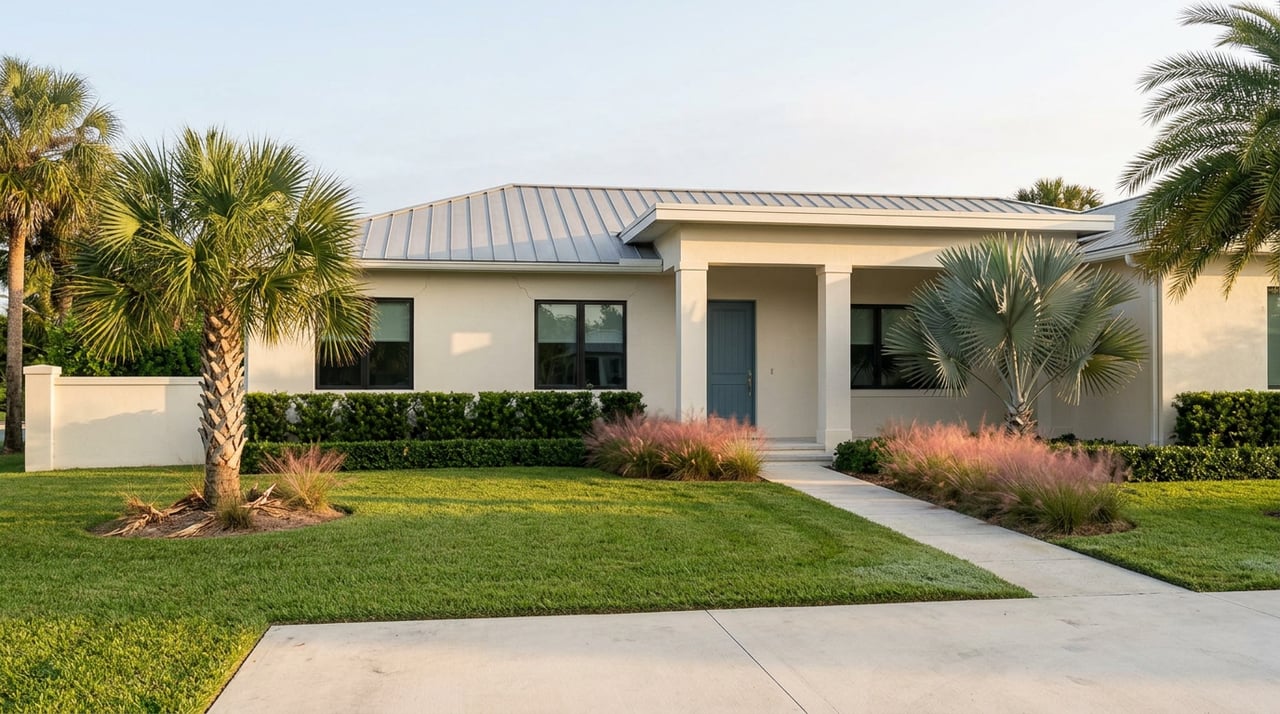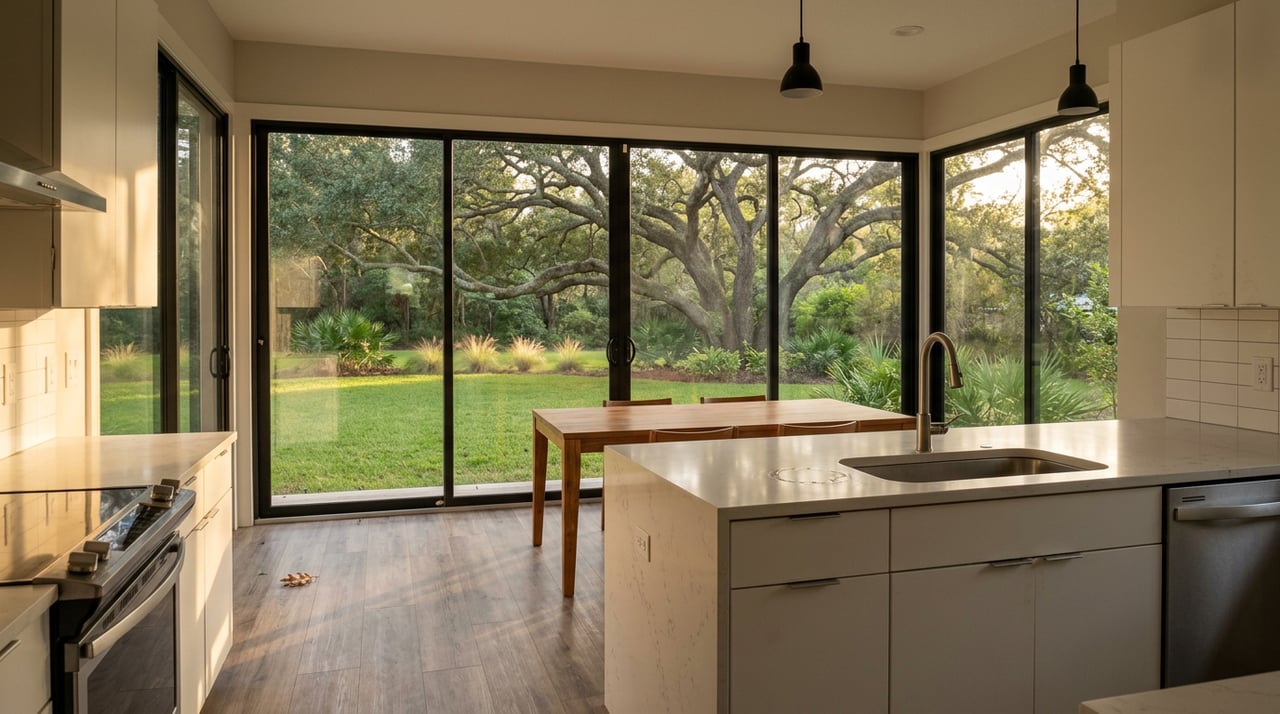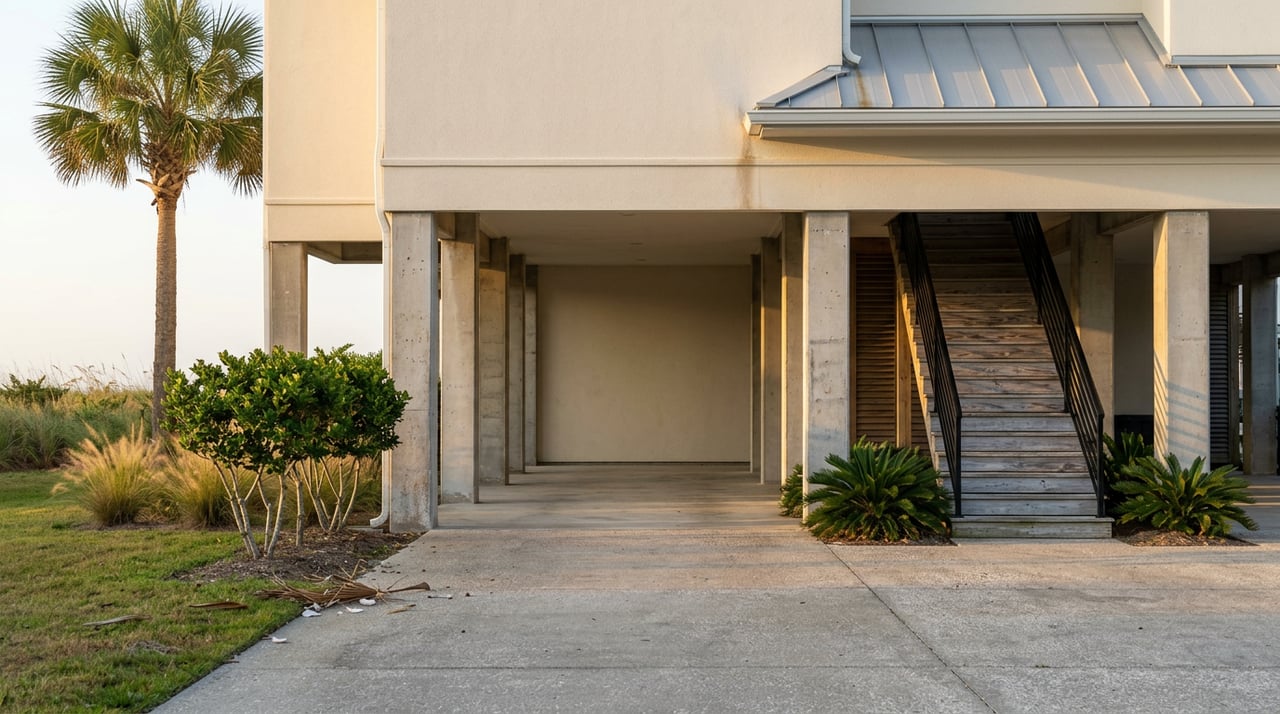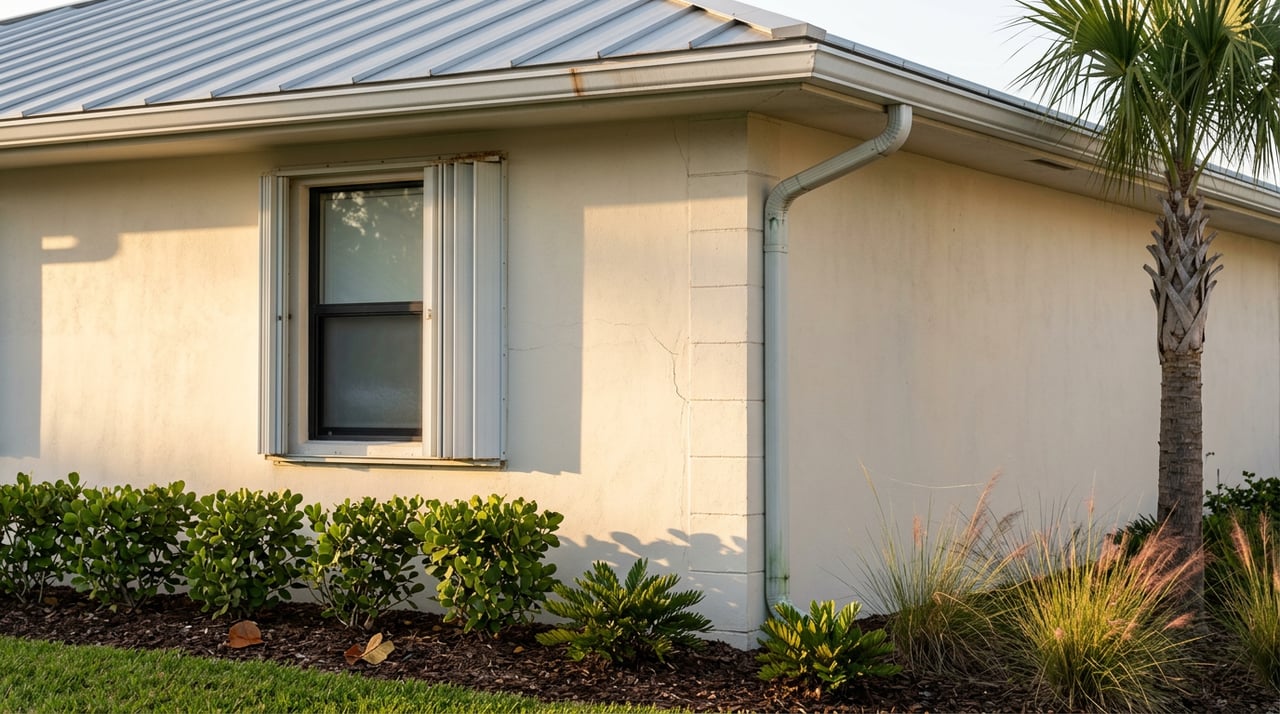
A concrete block home on Cocoa Avenue in South Indialantic sits on the market right now with a file most buyers never think to ask for. The roof was replaced in 2021. The kitchen was renovated in 2010. New Andersen windows and doors went in across the rear this year, and the front already carries hurricane-rated glass with shutters protecting the back. None of that shows up as a line item on the listing sheet. All of it shows up on the two forms that actually decide whether this house is insurable and what it will cost to keep that way.
A few blocks over, a different kind of Indialantic original sits in the same market: a 1954 concrete block bungalow in Casa Del Sol by the Sea, a community of just 28 homes, with a tile roof, an arched carport, and terrazzo floors original to the build. Same barrier island. Same walk to the beach. Very different paper trail.
The gap between these two houses is not the year they were built. Indialantic incorporated in 1952, and its growth accelerated afterward as the postwar Space Coast boom drew workers to the aerospace facilities taking shape nearby in Melbourne and Cape Canaveral. Like the other beachside towns on this stretch of barrier island, a meaningful share of Indialantic's original housing dates to the 1950s through the 1970s, long before the construction standards Florida insurers check today existed. Almost none of that original stock will clear the newer thresholds unless someone has already done the work. The gap is whether the roof, the openings, and the wiring have crossed specific dates written into state insurance forms. Those dates, not the asking price, are what a lender's underwriter and an insurance carrier will care about before this deal closes.
Two inspections, two different questions
Florida buyers on older homes run into two separate reports that get confused constantly because both involve a person walking through the house with a clipboard.
A 4-point inspection asks one question: can this home be insured at all. It looks at the roof, electrical panel, plumbing, and HVAC system and flags the things that make carriers walk away entirely, like a Federal Pacific electrical panel or polybutylene plumbing.
A wind mitigation inspection asks a different question: how much of a discount does this home earn. It documents the construction features, using the state's standardized form, that make a house more likely to survive a hurricane intact.
One decides if you get a policy. The other decides what that policy costs.
Homes with an aging roof, or one that has never been evaluated, usually need both inspections handled around the same time, because the roof shows up on both forms for different reasons.
Why 2001 is the line that resets the clock
The wind mitigation form Florida uses is officially called the Uniform Mitigation Verification Inspection Form, OIR-B1-1802, and the state's Office of Insurance Regulation updated it effective April 1, 2026 following a 2024 wind-loss mitigation study. The form scores several construction details, and the first one is often the one that determines everything else.
| What the form checks | What earns credit | Why it matters on an older Indialantic block |
|---|---|---|
| Roof covering | Installed to the 2001 Florida Building Code or later | Most original Indialantic roofs predate this by 20 to 50 years and need a documented replacement to qualify |
| Roof deck attachment | Nail size, spacing, and pattern securing the decking to the trusses | Rarely upgraded unless the roof itself was replaced, so it usually resets alongside the roof covering line |
| Roof-to-wall connection | Hurricane clips or double-wrap straps score higher than simple toe nails | This is frequently the single line item that changes the outcome of the whole inspection |
A house can have a beautifully renovated kitchen and still score poorly here if the roof above it has never been touched since the original build. That is the mechanism behind the Cocoa Avenue and Casa Del Sol comparison. One property has a 2021 roof on file. The other, unless its owner has separately documented an upgrade, is working from a 1954 baseline.
What a hardened older home actually looks like on paper
The Cocoa Avenue listing is a useful reference point precisely because its improvements are dated and specific rather than described in general terms. A 2021 roof clears the building code line. Hurricane-rated windows on the front and shutters on the rear address the opening protection line. New Andersen windows and doors installed this year extend that protection to the rear elevation. None of these are cosmetic upgrades in the way a kitchen renovation is. They are the specific line items an insurance underwriter is reading for.
That is the practical difference between a home a Florida insurer writes a full policy on without hesitation and one that gets flagged for a 4-point before a carrier will even quote it.
The grant program that got real money again, one year ago today
Florida's My Safe Florida Home program reopened its application portal exactly one year ago today, on August 4, 2025, with $352 million in funding for the 2025 to 2026 cycle. The program pairs a free wind mitigation inspection with a matching grant, typically two state dollars for every homeowner dollar spent, up to $10,000 toward hardening work like impact windows, impact doors, and roof reinforcement.
Eligibility runs on three hard lines: an active homestead exemption, an original building permit dated before January 1, 2008, and an insured value under $700,000. For most of Indialantic's original housing stock, the pre-2008 line is not the obstacle. Homes built in the 1950s through 1970s clear it by decades. The actual constraint is the income limit, which restricts the grant portion, though not the free inspection, to low and moderate income households, with applicants over 60 processed first.
This spring's state budget deal, reached over Memorial Day weekend 2026, reappropriated more than $405 million across the program and its condo pilot, aimed specifically at roughly 45,000 homeowners statewide who completed an inspection in an earlier cycle but never received a grant before funds ran out. If a seller in Indialantic already has a wind mitigation inspection on file from a prior year and never followed through on hardening work, that inspection may still be active and that backlog funding may still apply.
When the paperwork says land value, not house value
Not every candidate on Indialantic's older blocks is a hardening project. Some are a different kind of math entirely.
True vacant lots on Brevard County's barrier island are scarce, because most of the buildable land was developed decades ago. When a genuinely dated home comes up, buyers increasingly treat it as a land purchase with a demolition line item attached. Demolition on the barrier island typically runs $15,000 to $25,000 depending on size and condition, and even a run-down original-era home can sell for more than $350,000 on land and location alone. Homes from the 1950s in particular can carry cast iron sewer lines or aluminum wiring that cost enough to bring current that a full renovation approaches the cost of building new.
Knowing which bucket a target home falls into before ordering a 4-point matters, because a failing report on an intact renovation candidate is a negotiating point. The same failing report on a home already priced near land value is simply confirmation of the plan you already had.
What this means before you write an offer
Ask for the current 4-point and wind mitigation reports before you go under contract, not after. If neither exists, ask whether the seller will order one, since the cost is modest against what it reveals. Check whether the roof and any window or door replacements have a permit date that crosses 2001, since that single line drives a meaningful share of the wind mitigation score. If the home was built before 2008 and either you or the seller might qualify on income, the grant backlog funding released this spring is worth a conversation before assuming an original roof is simply a repair bill.
FAQ
How long does a wind mitigation report stay valid? The Uniform Mitigation Verification Inspection Form is valid for up to five years, as long as no material changes are made to the roof, windows, or doors in the meantime.
If a home already has hurricane shutters, does the grant cover swapping them for impact windows? Usually not. Program guidance treats openings that are already code compliant as ineligible for a swap, since the grant is meant to close gaps, not upgrade features that already pass.
What if I don't qualify for the grant because of income? The matching grant is limited to low and moderate income applicants, but the free wind mitigation inspection itself has broader availability. Higher income buyers can still request the inspection and use the resulting report for insurance discount purposes, even without the matching funds.
Older Indialantic homes reward buyers who read the permit history as carefully as the listing description. If you are circling a property on this barrier island and want a clear read on what its roof, wiring, and windows actually mean for financing and insurance before you write an offer, MVP Sales Group can walk the paperwork with you and help you make the call with real numbers in hand. Schedule your personalized Space Coast market consultation.