If you moved here in the last few years, someone probably told you Melbourne Beach takes sea turtles seriously. What that phrase leaves out is the scale. Your front door sits inside the northern end of a 20.5 mile stretch of sand that hosts more loggerhead nests than any comparable beach on Earth, and the rulebook that protects those nests treats your living-room lamp as beach infrastructure from May 1 through October 31.
That is the part most residents miss. The lights-out ordinance is not a beach rule. It is a house rule, and the place it usually breaks down is not the porch light.
A nest every few feet, and why that matters at your address
In the 2023 season, UCF's Marine Turtle Research Group counted 15,174 loggerhead nests and 23,220 green nests inside the Archie Carr refuge, a record green season with an increase of more than 8,000 nests from the previous year. Spread across the 20.5 miles of beach and shoreline between Melbourne Beach and Wabasso Beach, that is not an abstraction. Loggerheads at the refuge annually produce between 8,000 and 20,000 nests, averaging 400 to 1,000 nests per mile, and in the densest sections older refuge literature describes roughly one loggerhead nest for every three feet of beach.
Translate that into your walk to the water. If your dune crossover lands anywhere between Ocean Avenue and Coconut Point, the sand in front of your home is doing measurable work in the global recovery of two endangered species. The refuge contains some of the world's most significant habitat for loggerhead and green sea turtle nesting, and nationwide, roughly a quarter of all loggerhead nests and a third of all green nests are laid at Archie Carr. That density is why a single bright window can misdirect dozens of hatchlings on a single August night.
What the ordinance actually asks of your house
The town publishes the rule plainly. The Town of Melbourne Beach and Brevard County have a Lights Out for Sea Turtles ordinance effective May 1 through October 31 that requires all lights visible from the beach to be covered, blocked, moved, or turned off after 9 p.m., and that includes flashlights, cellphones, and red lights.
Two details in that sentence surprise people every year.
The 9 p.m. line is not just for beachfront homes
East of the Banana River you are subject to the ordinance, which covers Cocoa Beach, Cape Canaveral, Satellite Beach, Indian Harbour Beach, Indialantic, Melbourne Beach, and everything down through Sebastian Inlet, and mainland properties can fall inside the ordinance too if any part of the building has direct line-of-sight to the beach. Second-row homes with a sightline over a low dune, corner lots on Riverside, and any residence with a two-story great room facing the ocean are all in scope. If a person standing on the sand can see the bulb, or the glow of the bulb reflected off a wall or a pool, the fixture is regulated.
Interior lights count, and this is where compliance falls apart
The FWC guidance is explicit about the mechanism. White lights inside the building can be visible from the beach and are often much brighter than the exterior lights. A property manager who works Brevard associations put it more bluntly: balcony lights, patio lamps, and the interior lights owners leave burning in beach-facing units are where compliance actually falls apart; you can retrofit every fixture on the property and still get cited because the owner in unit 502 leaves a chandelier on with the curtains open, and code enforcement does not distinguish between association fixtures and owner fixtures when it writes a citation.
For a single-family owner, the same logic applies to your own kitchen island pendants and your family-room television glow.
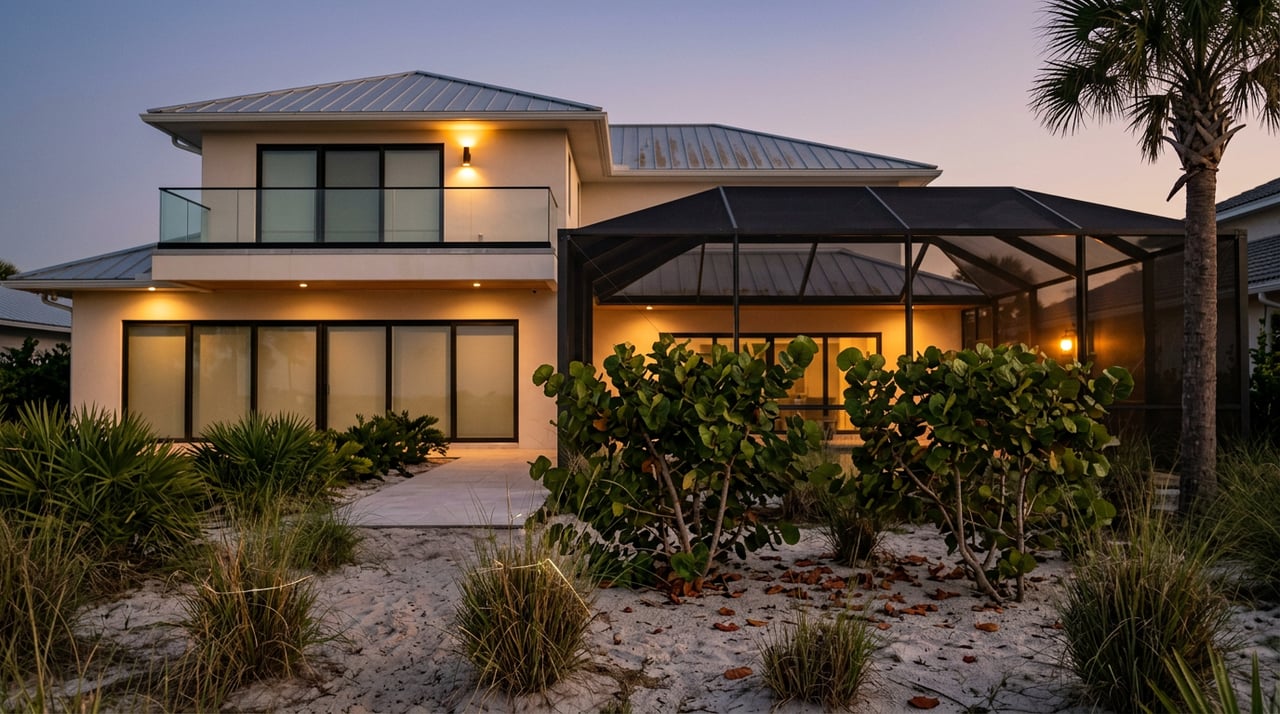
If your pool cage is amber-compliant but the sliders behind it are wide open with the kitchen lit, the beach reads one big rectangle of white light. The dune does not know which fixture is yours.
A ten-minute audit you can do tonight
The FWC's own guidance for property owners is to turn off unnecessary lights, avoid decorative lighting like runner lights or uplighting of vegetation visible from the beach, reposition or disable fixtures that cannot be modified, and shield the light source from all areas on the beach, not just from the beach directly in front of the light. Translate that into a walk-through.
- Step onto your dune crossover after 9 p.m. and turn around. Anything you can see from that vantage is in scope.
- Look for globe lights and carriage lanterns first. FWC recommends replacing fixtures that scatter light in all directions, such as globe lights or carriage lights, with directional or recessed fixtures that point down and away from the beach.
- Check your bulb color. Exterior lights visible from the beach have to be shielded, the bulb should not be directly visible from the sand, and the bulb itself has to be long-wavelength, above 560 nanometers on the visible spectrum, which in current products means amber LED or true red LED.
- Walk to your pool. Pool lights can be locked on an amber or red color during nesting season, and vegetation buffers can help block cumulative glow from the beach.
- Look at your windows from the sand. If you see the room, so does a hatchling. Tints meeting the 45 percent or less inside-to-outside transmittance standard on beach-facing glass, blinds or curtains drawn at night, and light fixtures moved away from windows all reduce interior light spilling onto the beach, and tints as low as 15 percent have been used successfully.
- Kill the decorative stuff. Uplights, string lights, and lights in trees serve no purpose for human safety and should not be turned on until after nesting season ends October 31.
- Save the Town of Melbourne Beach sea turtle page in your phone before code enforcement saves your address.
If you want to read the rule itself, the town posts Chapter 40, Article II of the code online.
Where to see a nesting turtle without breaking the rule
The impulse to walk down alone with a red flashlight is exactly the thing the ordinance is written against. The right move is a permitted walk. Your options in 2026 are unusually good, and they concentrate in the two-mile stretch closest to home.
| Operator | Meeting point | 2026 schedule | Cost |
|---|---|---|---|
| Barrier Island Center (Sea Turtle Conservancy) | 8385 S Hwy A1A, Melbourne Beach | Wednesdays through Fridays in June and July | $15 donation per person, paid in advance |
| Sea Turtle Preservation Society | Coconut Point Park, 3535 S Hwy A1A, Melbourne Beach | Saturday, Sunday and Wednesday in June and July | $20 |
| Sebastian Inlet State Park | 9700 S Hwy A1A, Melbourne Beach | Monday and Wednesday nights, May 27 through August 5, 9 p.m. | $30 per participant |
| Stella Maris Environmental Research | Melbourne Beach, private permit | Select nights each June and July, groups of up to 20 | Varies |
A few things to know before you book. Reservations open May 1 and fill within days. Nighttime walks routinely sell out; single-family walks sometimes remain available after the main slots close. And no, the refuge itself does not conduct sea turtle walks, digs or releases, so anyone offering a walk under the Archie Carr name is really one of the partner organizations above.
Bring closed-toe shoes, water, and patience. No flashlights or cameras are allowed on guided walks to protect the turtles.
The part locals underestimate: hatch season
Nesting gets the attention. Hatching is where the neighborhood actually pays for its lighting habits.
Once the eggs are laid, they incubate in the warm sand for about 60 days, and each nest houses around 100 eggs. Do the math forward from July. A nest laid the week of the Fourth of July hatches around Labor Day. Nesting activity decreases in the fall, but the hatchlings are just getting started; nests laid in August may hatch in October.
Which means the window when your beach-facing living room can do the most damage is not June, when everyone is paying attention. It is late September, when the walks are over, the crowds have thinned, and the ordinance is still in force. When hatchlings emerge, they orient toward the brightest light on the horizon, which under normal conditions is the moon reflected off the ocean, but if a pool deck light is brighter than the moon, the hatchlings crawl inland instead, and most of them do not survive.
The next time you leave the porch light on because you forgot, imagine 100 quarter-sized turtles walking under your car instead of into the surf. That is the actual stakes of the switch on your wall.
The researchers whose data you are contributing to
Living inside the refuge means your beach is a lab. In 1982, UCF professor Dr. Llewellyn Ehrhart and his students began studying nesting behavior in central and south Brevard County, the data they collected prior to 1991 was crucial in helping establish the Carr Refuge, and today UCF's Marine Turtle Research Group has compiled over 40 years of data on sea turtle nesting and reproductive success in partnership with the U.S. Fish and Wildlife Service. Stella Maris Environmental Research, founded in 2014 and based inside the refuge, focuses on sea turtle research and public education including eco camps, nest digs and night walks. Their current work involves studying how artificial light in the refuge causes disorientation for hatchlings emerging from their nests.
The Barrier Island Center at 8385 S A1A is where their public-facing work lives. The Barrier Island Sanctuary Trail starts at the visitor center at 8385 S Hwy A1A and leads to beach access through a maritime hammock and dune ecosystem, and it is genuinely worth an hour of a summer morning even if you have driven past it a hundred times.
If you find a disoriented hatchling in your driveway, or a nesting female stuck in landscaping, the Sea Turtle Emergency Response Hotline is 321-206-0646, and for injured manatees, dolphins, or whales, Florida Fish and Wildlife is 1-888-404-3922. Program both into your phone before you need them.
The tradeoff you signed up for
Owning a home in Melbourne Beach means owning a small piece of a globally significant nursery. The tradeoff is that from May through October, your exterior lighting choices, your window treatments, and the switch by your front door are not fully yours. They belong, for a few hours a night, to a species that has been coming back to this specific sand for longer than any of us have had a mailing address here.
The residents who love it here longest tend to describe that arrangement as the good part.
If you are thinking about buying, selling, or renovating an oceanfront or second-row home and want an honest read on how nesting-season compliance affects lighting plans, pool designs, or resale presentation, MVP Sales Group works with owners across Melbourne Beach who take this stewardship seriously. Schedule your personalized Space Coast market consultation and we will walk your property with the ordinance in mind before the next hatch.